[barbelith/temple]
[fusionanomaly]


une description dynamique de la réalité, où les humains sont des agents à part entière de la réalité, capable d'influencer son cours.....
[barbelith/temple]
[fusionanomaly]
A concept introduced by Carroll is the gnostic state, also referred to as gnosis. This is defined as a special state of consciousness that in his magic theory is what is necessary for working most forms of magic. This is a departure from older concepts which described energies, spirits or symbolic acts as the source of magical powers. The concept has an ancestor in the Buddhist concept of Samadhi, made popular in western occultism by Aleister Crowley and further explored by Austin Osman Spare.
The gnostic state is achieved when a person's mind is focused on only one point, thought, or goal and all other thoughts are thrust out. Users of chaos magic each develop their own ways of reaching this state. All such methods hinge on the belief that a simple thought or direction experienced during the gnostic state and then forgotten quickly afterwards is sent to the subconscious, rather than the conscious mind, where it can be enacted through means unknown to the conscious mind.
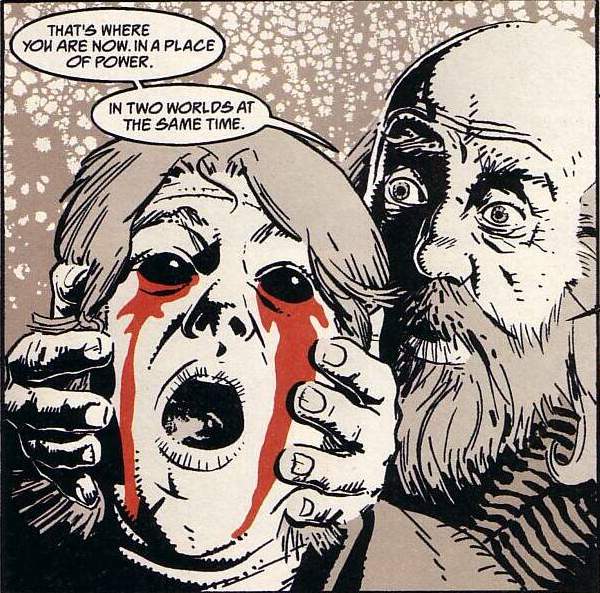


"Reality lies in the blur."
"Reality IS the blur."

"La réalité est la bave laissée par l'escargot cosmique le long de sa descente dans la spirale du temps."

"Se téléporter c'est facile une fois qu'on sait tordre la réalité." (ou qu'on a un jumeau)

"Classiquement, il y a quatre perspectives pour voir et expliquer le monde."


Perhaps the most striking feature of chaos magic is the concept of the magical paradigm shift. Borrowing a term from philosopher Thomas Kuhn, Carroll made the technique of arbitrarily changing one's model (or paradigm) of magic a major concept of chaos magic. An example of a magical paradigm shift is doing a Lovecraftian rite, followed by using a technique from an Edred Thorsson book in the following ritual. These two magical paradigms are very different, but while the chaote is using one, he believes in it fully to the extent of ignoring all other (often contradictory) ones. The shifting of magical paradigms has since found its way into the magical work of practitioners of many other magical traditions, but chaos magic remains the field where it is most developed.
The main tenet of Chaos Magick is that "Nothing is True and Everything is Permitted," a quote attributed to Hassan I Sabbah. Like Crowley's "Do what thou wilt shall be the whole of the law," this phrase is often mistakenly interpreted in its most literal sense to mean "there is no such thing as Truth, so you can do whatever you want." However, "Nothing is True and Everything is Permitted" is more widely interpreted to mean "there is no such thing as an objective truth outside of our perception; therefore, all things are true and possible."
The idea is that belief is a tool that can be applied at will rather than unconsciously. Some chaos magicians think that trying unusual, and often bizarre beliefs is in itself an experience worth having and consider flexibility of belief a form of power or freedom in a cybernetic sense of the word.

"Material reality is a consensual hallucination which the vast majority of humanity agrees upon."
"The closer the personal paradigm is to static reality, the easier it is to impose will upon the world."


Sigils and servitors are the fast food of Chaos Magick.

"Three-dimensional space is an illusion, all points of space are or can be united."